Guide · climate
Vevor 12V Mini Split in a Real Van: Install Notes and First Field Test
Published July 17, 2026 · Last verified July 18, 2026
Disclosure: this article contains affiliate links from the following programs: Amazon Associates. They pay us a commission and never touch our conclusions. Details in the affiliate disclosure.
Twelve-volt mini splits barely existed in the US market a year ago, and if you search for an independent review of one you will find approximately nothing: vendor pages, retailer listings, and forum threads full of people asking the same unanswered questions. We can start fixing that, because one of these units is installed in our van. Bought with our own money, mounted on the rear door of a Ram ProMaster high roof, and field-tested at a music festival in Tennessee summer heat.
This is field log #1: the install experience and the first real-world runtime data. It is deliberately not a scored review yet. Our scores require instrumented measurements, per How We Test, and the amp-clamp and delivered-cooling numbers are the next entry in this log. What follows is what we know so far, with the claims and the observations clearly separated.
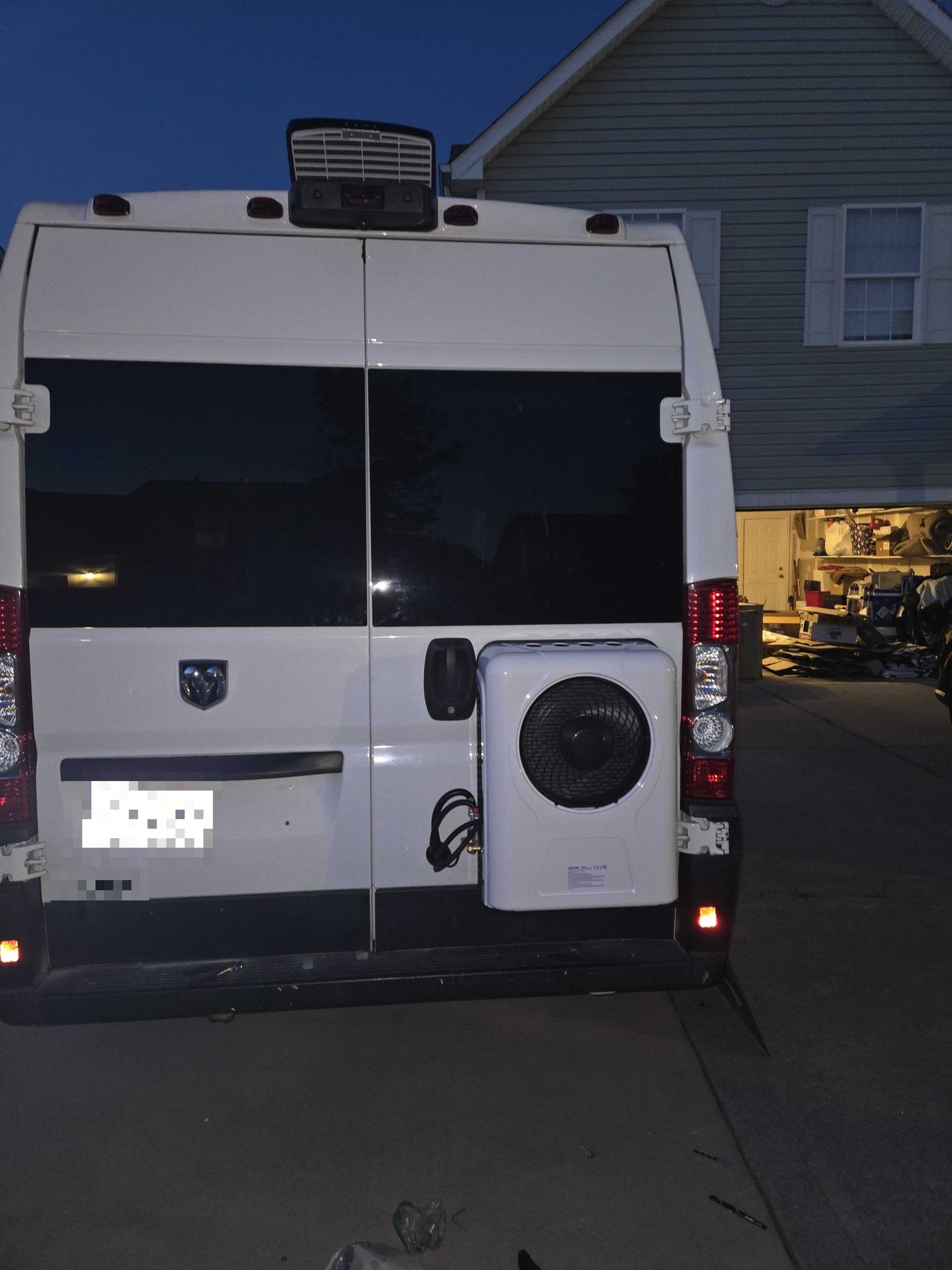
The unit
Ours is the Vevor-branded version of the compact 12V split that now floods Amazon and vendor sites under several labels. These units appear functionally identical to the Treeligo 12,000 BTU listing on Amazon, and supplier pages openly offer this hardware white-labeled with any brand and packaging. Until we tear ours down and match component markings, “appears identical” is as far as we will go.
Manufacturer claims for this class of unit, which we have not yet verified:
| Spec | Claimed | Our verdict |
|---|---|---|
| Cooling capacity | 12,000 BTU | Not yet measured. We are skeptical: at a claimed ~960W max input, 12,000 BTU implies an efficiency that would be remarkable for budget R134a hardware. Measuring delivered cooling is Test #1. |
| Max power draw | ~960W (~80A at 12V) | Not yet measured. Amp-clamp curves are Test #2. |
| Noise | 45 dB | Not yet measured. |
| Refrigerant | R134a, pre-charged | Ours ran without any refrigerant work. Details below. |
The install: about 4 hours, and our unit really was connect-and-run
The architecture is a true split: a condenser unit mounted outside on the right rear door, an evaporator head mounted inside on the same door, and refrigerant lines joining them through the door skin. Total working time was about 4 hours.
The finding worth reporting: our unit needed no vacuum pull and no refrigerant top-up. We connected the pre-charged lines and it ran. That matters because listings in this product class are genuinely contradictory about what “pre-charged” means. Some Vevor listings state a vacuum pump must purge the indoor unit and lines before opening the valves. Older Treeligo listings shipped the compressor with oil but no refrigerant at all, requiring roughly 500g of R134a before first start. Which experience you get appears to depend on the exact SKU and production run, and the listings will not tell you reliably.
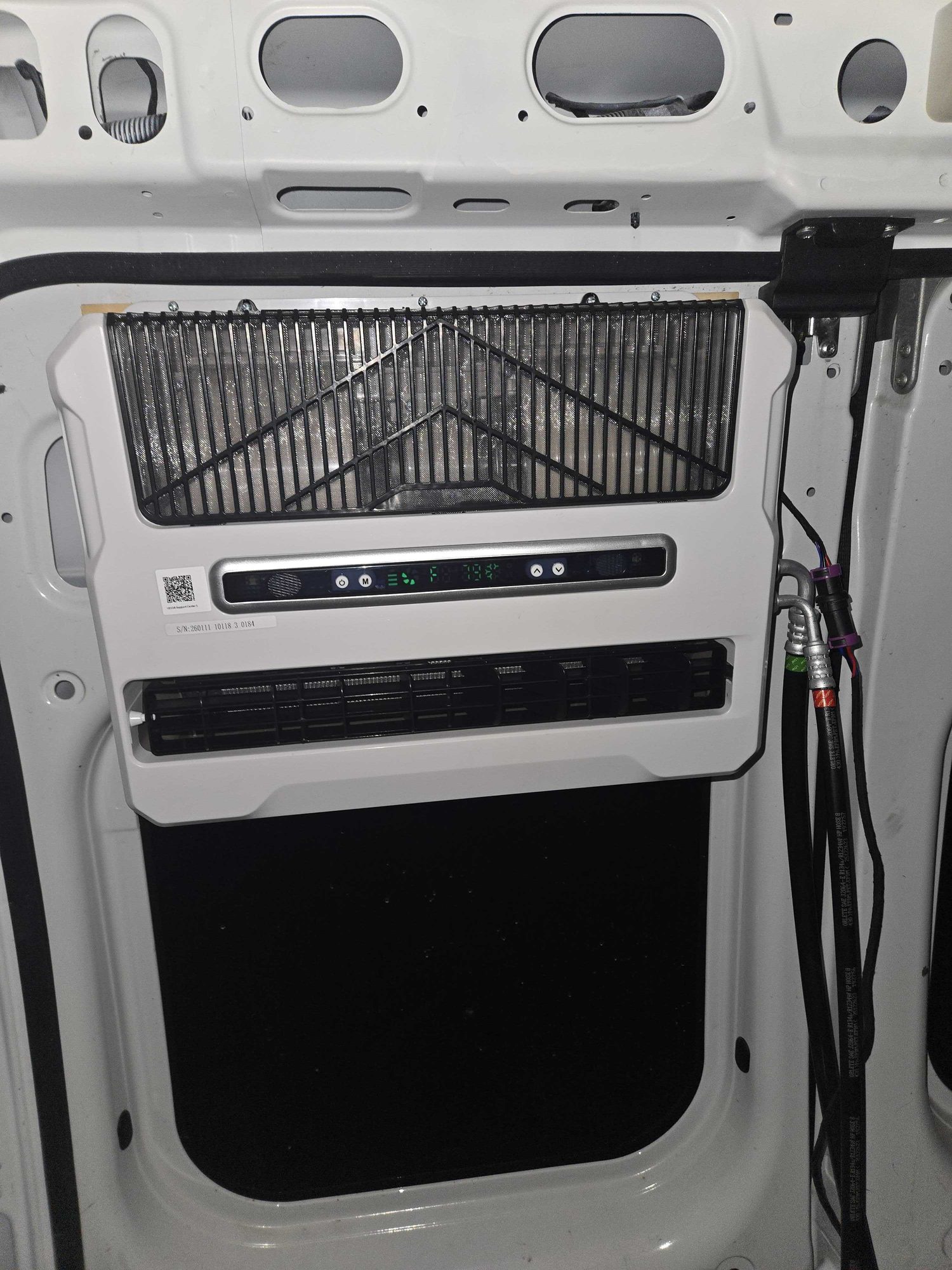
Two honesty notes on that. First, one connect-and-run experience is one data point, not a guarantee about the unit you would receive. Second, an HVAC professional would tell you that skipping evacuation risks air and moisture in the loop, which can quietly cost performance and longevity. Ours is running well so far. If that changes, this log will say so, and the unit’s months-in-service counter will keep running either way.
The usual disclaimer applies and will appear on every article in this category: we are not HVAC technicians or electricians. This article describes what we did with our own equipment. It is not an instruction manual, and refrigerant work beyond sealed quick-connect fittings is a job for a certified tech.
The festival test: three hours on a 100Ah battery, and the battery was the limit
The first sustained real-world run happened at a festival in Tennessee, in July heat, which is about as honest a stress test as a van cooling setup gets.
The power chain: the mini split was connected directly to a 100Ah 12V battery. That battery was being recharged by a Bluetti D40 feeding from an AC200L power station, which was itself topped by 400W of solar.
The result: on its lowest mode, the unit ran successfully from roughly 8 am to 11 am, about three hours of continuous cooling before the small direct battery gave out. The unit itself never struggled; the bottleneck was the 100Ah battery it was drawing from. Based on how the bank behaved, a larger battery bank should plausibly carry it through a full day on low, and that is exactly the claim we intend to test properly rather than assert. The other way around a battery bottleneck is a portable unit sold with its own dedicated battery pack, which is the pairing we compare in EcoFlow Wave 3 vs Zero Breeze Mark 3.
What this first data point already tells you: a budget 12V mini split on its lowest setting is a real, usable cooling tool on a modest battery, and it is not an all-night solution on 100Ah. Where the real line sits between those two statements is a measurement job, not an opinion job. Where this tier sits against portables, rooftop DC units, and the 120V workarounds is laid out in our guide to van air conditioning options.
The power chain, mapped — and why the battery quit first
Here is that festival chain drawn out, with a spec detail we dug up afterward that reframes the result:
The detail worth knowing if you are copying this setup: Bluetti’s spec sheet lists the D40 at 400W maximum, but its output drops to 12V/20A — roughly 270W — when its input is a power station rather than its 48V or PV input. So during those three hours the battery was being refilled at a claimed ~270W while the mini split drew more than that, and the gap is why the bank, not the unit, tapped out. In the full build this same 100Ah bank also exits through a Blue Sea fuse panel to a 12V fridge, a MaxxAir fan, and Starlink, which makes the recharge math tighter still. What the fix looks like — bank expansion, deployable solar into the D40’s own PV input, a direct alternator charger, and why the honest answer is a hybrid of all of them — got long enough to become its own article: the power station 12V ceiling guide.
What gets measured next
This log continues with instruments, in this order:
- Amp-clamp curves: fan only, lowest mode, and maximum, plus the startup transient. This turns “it ran for three hours” into watt-hours per hour you can size a battery bank against.
- Delivered cooling: inlet and outlet temperatures with airflow, to put a real number against the 12,000 BTU claim.
- Noise at a fixed distance, per mode.
- Overnight logging: watt-hours per night at recorded ambient temperatures, feeding a battery-sizing calculator for this whole category.
- The long-term log: this unit lives on our van now. Months in service, failures if they come, and what warranty support actually does about it.
If you are weighing one of these units against saving up for a premium 12V system, the honest current answer is: wait for our numbers, because nobody else has published any. The Amazon listing for the white-label sibling of our unit is there if you want to look at the claims yourself. Read them the way we now do: as claims.
More in this cluster: the complete van A/C price ladder, this unit vs the Dometic RTX 2000 and Velit, what pre-charged actually means, and the portable alternatives compared.
Frequently asked questions
Does a 12V mini split need a vacuum pump or refrigerant to install?
Ours did not: the lines were factory charged with quick-connect fittings and it ran the same afternoon. But listings in this product class contradict each other, and some SKUs require a vacuum pull or even a full R134a charge, which is a job for a certified tech. Check the paperwork in your box before install day.
How long will it run on a 100Ah battery?
In our field test it ran about 3 hours on the lowest mode from a single 100Ah 12V battery in Tennessee July heat, with the battery, not the unit, giving out first. Measured watt-hour logging is coming, which will make battery sizing a calculation instead of a guess.
Is the 12,000 BTU claim real?
Unverified, and we are skeptical. At a claimed 960W maximum input, 12,000 BTU implies an efficiency that would be remarkable for budget R134a hardware. Measuring actual delivered cooling is the first test on our bench, and no independent measurement exists anywhere that we could find.
What van is it installed on?
A Ram ProMaster high roof, as a rear-door split: the condenser mounted outside the right rear door and the evaporator head inside on the same door, with the refrigerant lines routed through the door skin.
Changelog
- July 18, 2026: Added the festival power-chain diagram, the D40's station-fed 20A recharge cap (which reframes why the battery quit first), and a link to the new power-station 12V ceiling guide.